
From AI Generation to AI Decisions: Meet Jev and System One Models
Prova il generatore di immaginiImgtovid AI Team
8 min read
From AI Generation to AI Decisions: Meet Jev and System One Models
Over the past few years, the rapid development of AI has been driven largely by advances in generation.
Large language models (LLMs) can now handle writing, programming, information summarization, instruction understanding, and complex reasoning. But as AI moves deeper into software, agents, and automated workflows, the problems software systems need to solve are changing:
What should happen next?
Which tool should be selected? Which agent should be called? Should a generated result be accepted or rejected? Should the system continue execution or request human review?
These tasks do not necessarily require a complete natural-language answer. They require a decision that can be directly incorporated into software logic.
This is the direction explored by System One Models, a new model category introduced by TypeSafe AI. In September 2026, TypeSafe introduced System One Models and launched Jev, its first publicly available model in this category, positioning it as an AI model designed for fast, structured decision-making inside software.
The core idea is simple:
AI does not only generate content. It can also participate directly in software decisions.
What Are System One Models?
TypeSafe describes System One Models as a type of AI model designed for fast, structured decision-making.
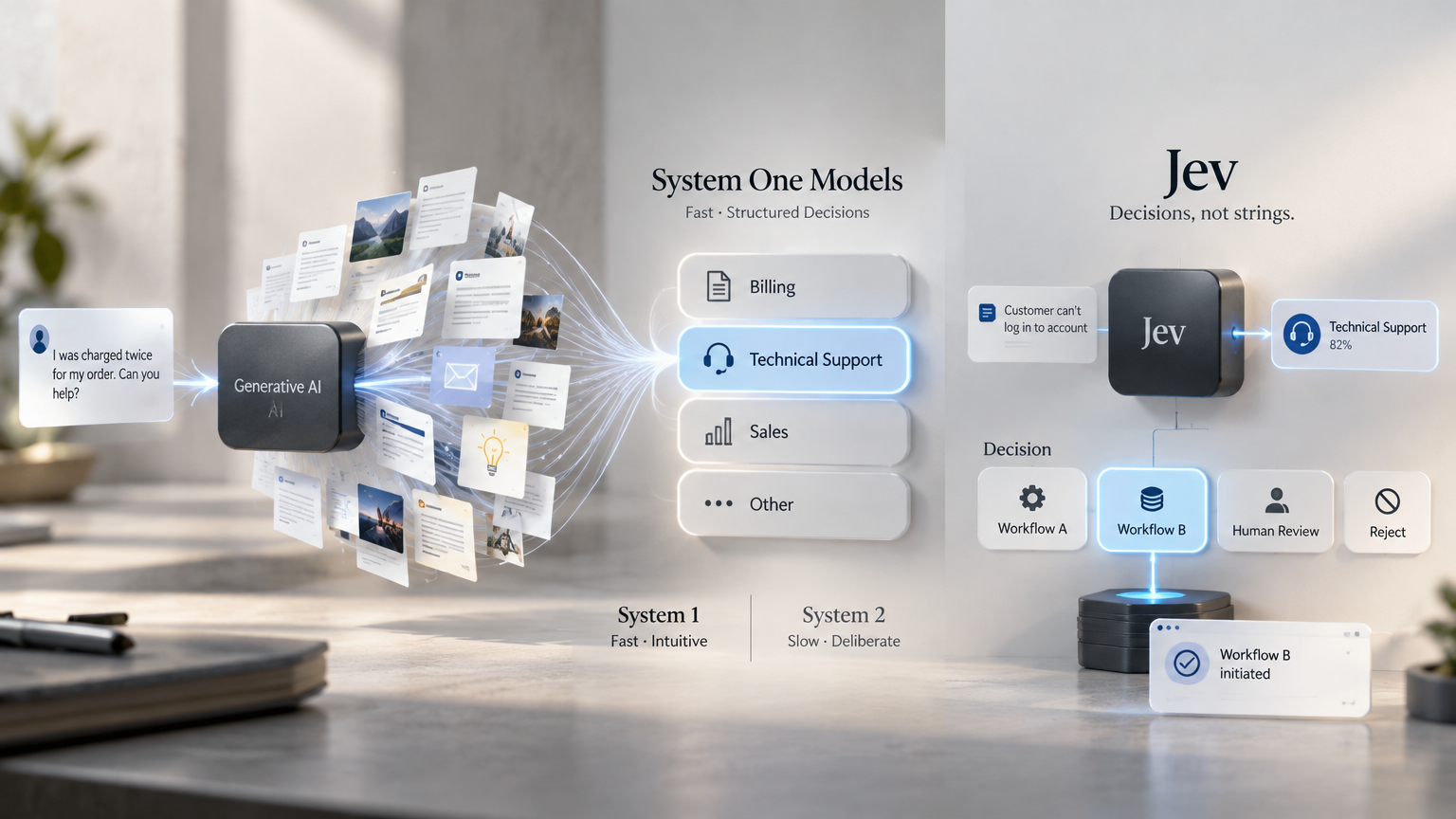
The name draws from the System 1 / System 2 framework of human thinking. System 1 is generally associated with fast, intuitive thinking, while System 2 represents slower and more deliberate reasoning. TypeSafe uses “System One” to describe models focused on fast software decisions rather than open-ended content generation.
Traditional generative models typically work like this:
Input → Open-ended content
A System One Model instead starts with a decision space defined by the application and selects an appropriate result based on the current state.
For example, consider a customer-support system. Instead of generating an open-ended response, the application may define four possible routes:
· Billing
· Technical Support
· Sales
· Other
What the software actually needs is a result that can be directly passed into its program logic.
This is reflected in TypeSafe’s concept:
“Decisions, not strings.”
In other words, the goal is not simply to generate another string of text, but to make a decision that software can use.
System One Models are therefore closer to an AI decision component inside software than to a conventional conversational model.
Jev: TypeSafe’s First System One Model
Jev is TypeSafe’s first publicly available System One Model and is currently in early access.
TypeSafe describes Jev as a model that takes unstructured state and produces typed probabilistic decisions.
For example, an AI workflow might need to answer:
“Which processing flow should this task enter?”
The application could define several possible outcomes:
Workflow A/Workflow B/Human Review/Reject
Jev can evaluate the current state, select an outcome, and provide probability or confidence information associated with that decision.
This makes the model relevant to tasks such as:
· AI agent routing
· Tool selection
· Workflow branching
· Request classification
· AI output verification
· Priority assessment
· AI guardrails
· Human-review triggering
TypeSafe also introduces a new model architecture for Jev, along with a parallel sampler and Reinforcement Learning for Calibrated Decisions (RLCD).
Together, these components are intended to support decision-making where the result needs to be both structured and useful to downstream software.
Traditional LLMs vs. System One Models
Dimension | Traditional LLMs | System One Models |
Primary goal | Open-ended generation and general reasoning | Fast, structured decision-making |
Typical input | Questions, instructions, and context | Application state and structured questions |
Output | Text, code, and other open-ended content | Predefined, typed results |
Output space | Usually open-ended | Can be predefined |
Typical tasks | Writing, programming, research, conversation | Classification, routing, scoring, verification, workflow control |
Software integration | Often requires parsing, validation, and handling of generated results | Designed to feed directly into program logic |
Uncertainty | Usually requires additional handling | Can provide probability and confidence information |
Typical role | Understanding, reasoning, generation | Judgment, selection, control |
Representative models | GPT, Claude, Gemini, and others | Jev and other System One Models |
This is not necessarily a replacement relationship. The two approaches address different types of problems.
General-purpose LLMs are well suited to open-ended language and reasoning, while System One Models are designed for judgment tasks where the possible outcomes are relatively well defined and the result frequently enters software execution logic.
This division of responsibilities is an important part of Jev’s positioning.
Why Do Typed Decisions and Confidence Matter?
When an AI output directly affects software behavior, predictability becomes important.
An LLM can be instructed to return JSON, for example, but at its core it is still performing token generation. The application may therefore need to parse the result, validate its structure, and determine whether the output can safely be used.
A System One Model starts from the decision itself and defines the possible output space.
Consider a simple decision:
Pass / Review / Reject
These three outcomes could correspond directly to:
· Publish automatically
· Send to human review
· Generate again
The model makes the judgment, while the software handles the resulting action.
Jev also provides probability and confidence information. Its RLCD approach focuses on decision calibration and uncertainty.
This creates the possibility of designing workflows such as:
· High confidence → execute automatically
· Medium confidence → perform additional verification
· Low confidence → request human review
Importantly, confidence should not be interpreted as a guarantee of correctness. Its value is that the model’s uncertainty becomes an explicit signal that the surrounding system can use.
How Can Jev Work with AI Agents and Automated Workflows?
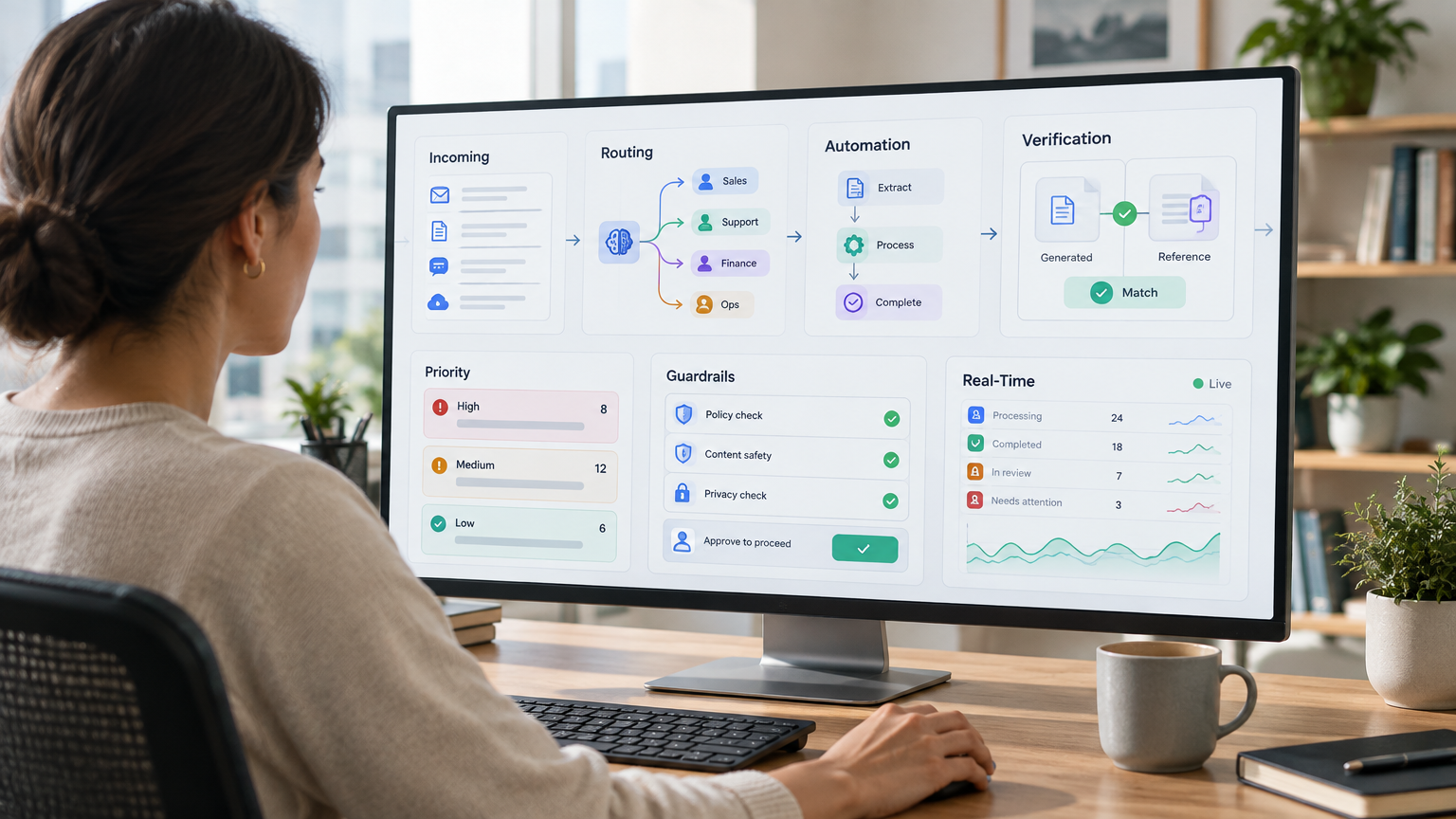
AI agents typically operate through a series of steps: understanding a task, selecting a tool, executing an action, evaluating the result, and determining what to do next.
Some of these steps require language understanding and complex reasoning. Others are essentially fast decisions among a limited set of possible options.
Jev can be used for the latter.
A possible architecture could look like this:
LLM → Understand the user’s request and perform complex reasoning
Jev → Select the appropriate tool, agent, or workflow
Specialized model → Perform the specific generation or analysis task
Jev → Determine whether the result meets the required conditions
Software → Execute the final operation
In this architecture, different models take on different responsibilities, while deterministic software logic remains responsible for state management and final execution.
This makes System One Models relevant to areas such as tool calling, agent routing, workflow branching, and result verification.
Where Can System One Models Be Applied?
System One Models are particularly relevant to software tasks that repeatedly require fast decisions within a predefined or constrained decision space.
AI Agent Routing
Determine which agent, tool, or next step should handle a task based on the current state.
Workflow Automation
Select the appropriate branch of an automated workflow based on context and intermediate results.
AI Output Verification
Determine whether a generated result meets predefined conditions before allowing the system to proceed.
Classification and Prioritization
Classify requests, assign priorities, or determine which items should be processed first.
AI Guardrails
Decide whether an input, output, or tool call should proceed, be blocked, or require additional review.
Real-Time Applications
Handle decisions where low latency is important and the software needs to respond quickly to changing states.
TypeSafe has demonstrated Jev in applications including real-time games and Wikiracing, as well as workflow evaluations focused on software execution.
The common requirement across these scenarios is straightforward:
Software constantly needs to determine what should happen next.
From a Single Model to a Modular AI System
The broader idea is not simply about Jev itself. It points toward a possible shift in how AI systems are designed.
A complex AI application may eventually contain several types of specialized components:
Language models: Open-ended understanding, reasoning, and generation
Generative models: Image, video, and audio creation
Decision models: Classification, routing, verification, and selection
Traditional software: State management, permissions, business rules, and final execution
Instead of a system that looks like:
User → One AI Model → Answer
the architecture can become:
User → Understanding → Decision → Specialized Model → Verification → Execution
System One Models explore the decision layer within this architecture.
Jev represents TypeSafe’s first public implementation of this idea.
If this approach is further validated, AI systems may gradually move away from relying on a single model to handle every task and toward modular systems in which multiple specialized models each perform the tasks they are best suited for.
Why Are System One Models Worth Watching?
The significance of System One Models is not simply that they introduce another type of AI model. More importantly, they attempt to embed AI more directly into the internal decision processes of software.
In complex AI systems, different models can take on different responsibilities: general-purpose models can handle understanding and reasoning, generative models can handle content creation, while System One Models can handle classification, routing, verification, and other fast judgment tasks.
This means AI does not always need to appear through a conversational interface. It can operate in the background, selecting tools, switching workflows, verifying results, or determining whether human intervention is required based on the current state.
Jev is TypeSafe’s first public implementation of this direction and is currently in early access. The more important question going forward is not a single benchmark number, but whether this type of decision-oriented model can operate reliably in real production environments and how it can work alongside LLMs, AI agents, and traditional software.
If this approach is further validated, AI applications may gradually move from depending on a single model toward modular systems composed of multiple specialized models.
Conclusion: From Generative AI to Decision AI
Over the past few years, some of AI’s most significant advances have centered on generation: writing, programming, reasoning, image creation, video generation, and natural interaction between people and AI.
As AI moves further into software itself, another question is becoming increasingly important:
Can AI directly help software decide what should happen next?
That is the direction explored by System One Models.
As TypeSafe’s first publicly available System One Model, Jev combines typed outputs, probabilistic decisions, confidence information, and a model architecture designed for software integration. Its goal is to allow AI to participate more directly in the judgment processes that take place inside software.
It is not designed to replace general-purpose LLMs. Instead, it explores a more specialized decision layer within AI systems.
Some models generate.
Some models reason.
Some models create.
And System One Models make decisions.

Grok Imagine Video 1.5 vs Seedance 2.0 vs Seedance 2.5: How AI Video Inputs Are Evolving

Image to Video AI: Dalle Immagini Statiche ai Video Cinematici AI

GPT Image 2
Scopri come GPT Image 2 alimenta la creazione di immagini in video tramite IA con ImgToVid AI, trasformando elementi visivi statici in clip dinamiche e coinvolgenti in pochi minuti.